

 ChatGPT
 Perplexity
 Claude
 Gemini
 Grok
Grok
Imagine you're a one-person marketing team with a product launch tomorrow and no video ready. You don't have time to hire a production crew or spend hours editing footage. That's exactly where AI video generators come in — and why so many creators are now looking beyond legacy tools like Synthesia for faster, more flexible alternatives.
In this guide, we'll break down the best Synthesia alternatives available today, what makes each one stand out, and how to choose the right AI video tool for your workflow.
Synthesia Review: Strengths and Limitations

If you're evaluating AI video generators for your workflow, understanding where Synthesia excels and where it falls short can save you hours of trial and error. This section gives you an honest breakdown so you can decide whether it fits your content goals or whether other AI video tools are worth exploring.
What Synthesia Does Well
Before exploring alternatives, it is worth acknowledging where Synthesia genuinely excels.
Synthesia is one of the most established AI video generators for structured, presenter-style content. Its core strength lies in producing talking-head videos where a digital avatar delivers a scripted message. This format works exceptionally well for corporate training and onboarding, internal communications, multilingual educational content, and product tutorials.
For these use cases, Synthesia's script-to-avatar workflow is well-optimized. Users write a script, select an avatar, choose a voice and language, configure scenes, and generate the video. The output is clean, professional, and predictable.
Where Synthesia Falls Short
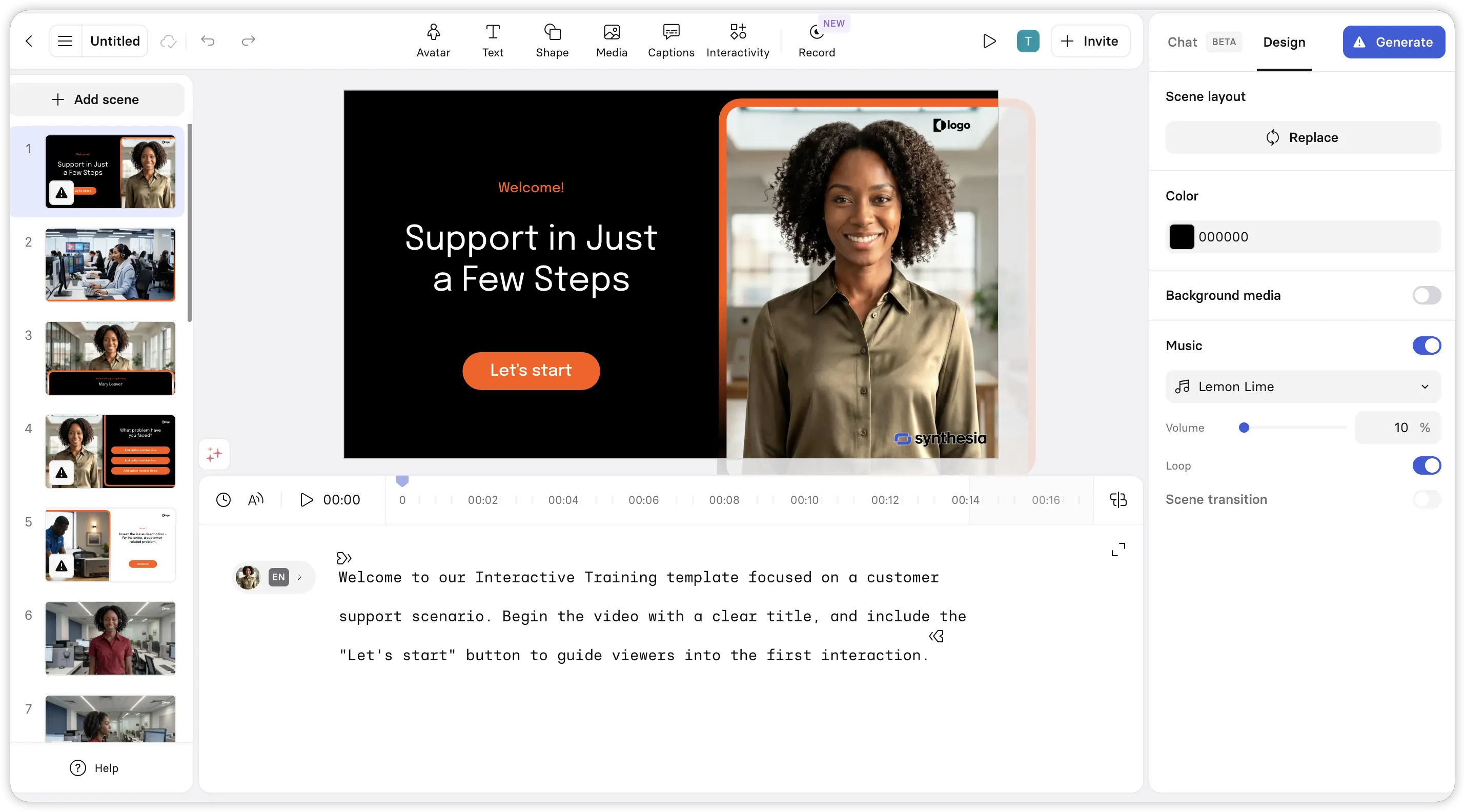
The same qualities that make Synthesia effective for structured content become limiting factors for more dynamic use cases.
Limited Video Style Variety
Synthesia is primarily a talking-head video generator. Nearly every output follows the same basic format: an avatar standing in front of a background, reading from a script. For corporate training, this is fine. For marketing videos, brand storytelling, or social media content, it quickly feels formulaic.
Creators who need product ad videos, user-generated content (UGC)-style clips, short-form social content, or cinematic storytelling will find that Synthesia's visual range simply does not extend that far.
Script-Driven Workflow Slows Iteration
Synthesia requires a fully prepared script before any video can be generated. This front-loads the creative process and makes rapid iteration cumbersome. If you want to test a different angle, tone, or message, you must revise the script, re-enter it into the system, and regenerate the video from scratch.
For teams that need to produce dozens of ad variations per week or respond quickly to trending topics, this workflow creates a real bottleneck.
Mismatch with Social Media Demands
Platforms like TikTok, Instagram Reels, and YouTube Shorts are built around dynamic storytelling, visual variety, and authentic-feeling content. AI avatar videos — by their nature — tend to look polished in a way that reads as corporate rather than native. They rarely stop the scroll.
This is not a flaw in Synthesia's execution; it is simply a reflection of the format's inherent limitations when applied to contexts it was not designed for.
Why Pexo AI Is a Strong Synthesia Alternative
Not every AI video generator fits every workflow — and what works for corporate training may fall flat for social content or ad production. In this section, we compare Pexo AI and Synthesia side by side across creative workflow, output variety, iteration speed, and ease of use, so you can judge which tool actually matches the way you work rather than forcing you to adapt to its limitations.
What Is Pexo AI?
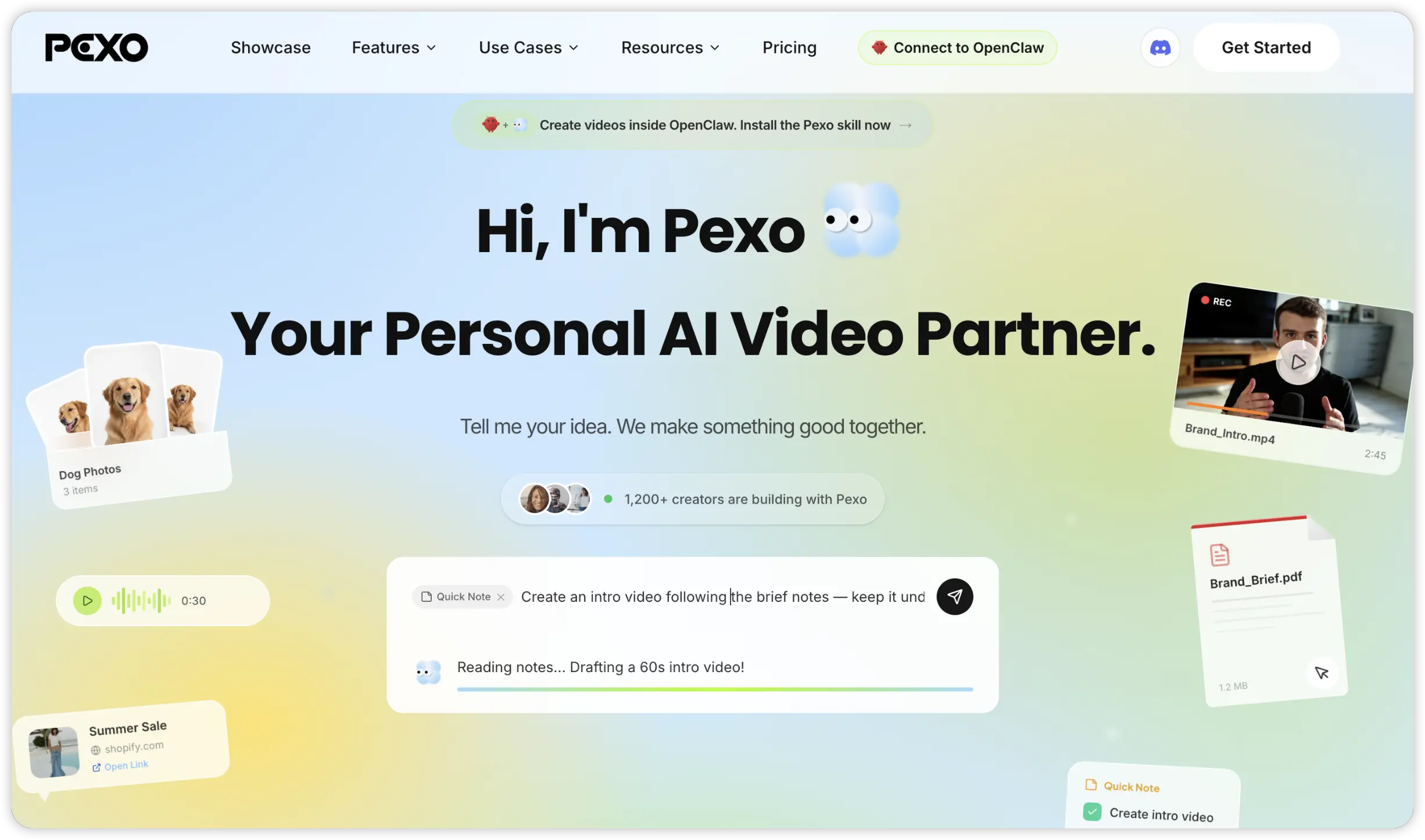
Pexo AI belongs to a newer category of AI video agents — platforms that do not just generate video assets, but actively collaborate with users throughout the creative process.
Rather than asking users to prepare scripts, configure settings, and manage timelines, Pexo operates through natural conversation. You describe what you want. Pexo interprets the idea, proposes creative directions with visual previews, selects the most appropriate AI models, and produces a finished video ready to post.
Pexo AI vs. Synthesia
| Feature | Pexo AI | Synthesia |
|---|---|---|
| Core concept | AI video agent | Avatar generator |
| Workflow | Conversation-based | Script-based |
| Prompt writing required | No | Yes |
| Video styles | Ads, UGC, social, anime, music | Avatar presentations |
| Editing interface | No timeline | Scene editor |
| AI model selection | Multi-model, automatic | Avatar-focused |
| Iteration speed | Instant, conversational | Manual script revision |
1. A Completely Different Creative Workflow
The most fundamental difference between Synthesia and Pexo is the direction of the workflow.
Synthesia is script-driven: you come in with a finished script and the platform executes it. Pexo is idea-driven: you come in with a rough concept — even a half-formed one (e.g., "Create a 15-second TikTok ad for my skincare product. Keep it cozy and authentic-feeling.") — and the platform helps you develop it into a finished video.
This shift matters because most creative work does not begin with a polished script. It begins with an instinct, a reference image, a vague sense of the tone you are after. Pexo meets creators at that stage. Synthesia does not.
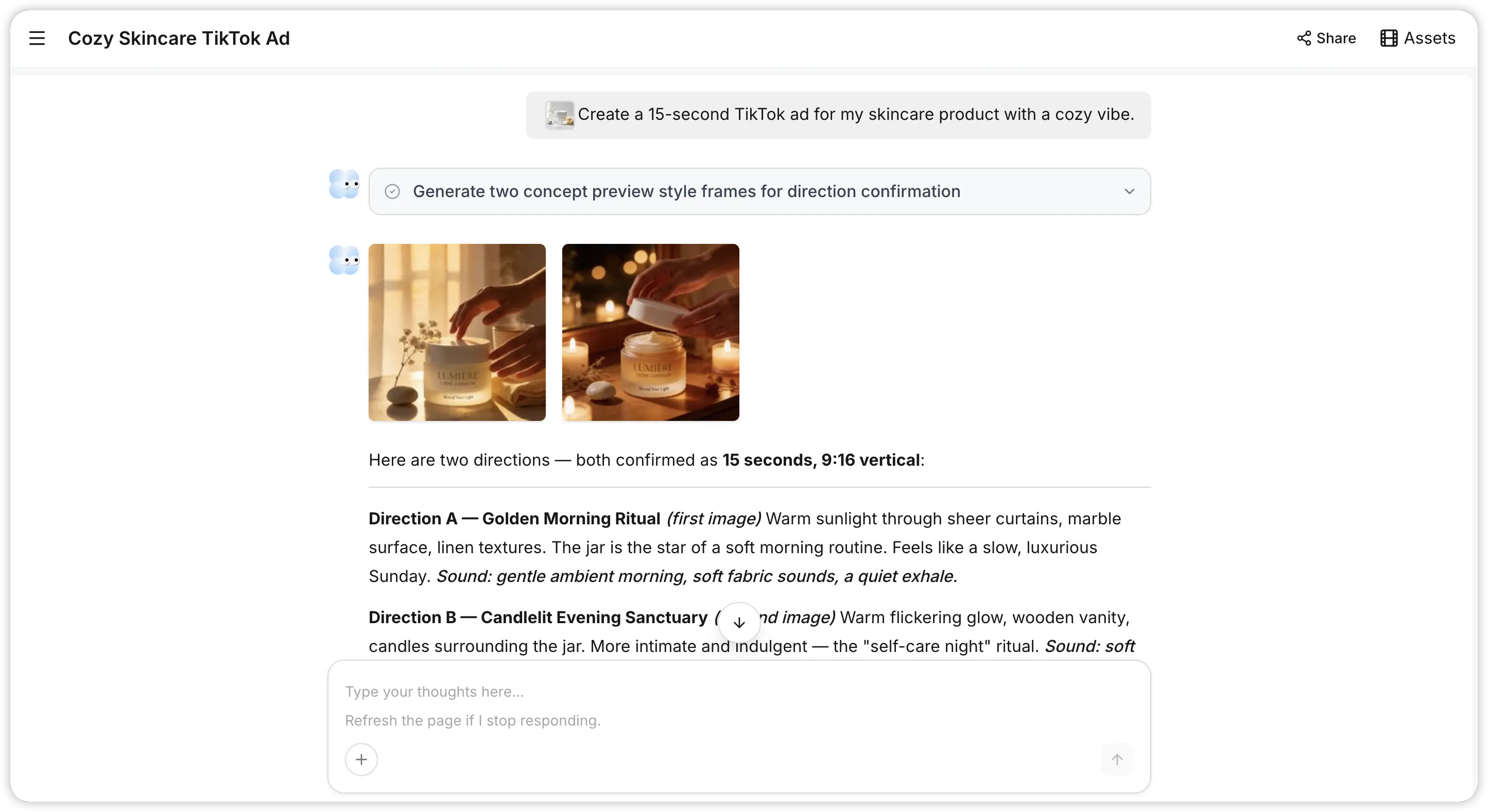
2. Broader Range of Video Formats
Pexo supports a significantly wider variety of output formats by automatically matching your creative needs with multiple underlying AI models, including Seedance, Kling, and Veo. It can effortlessly produce high-converting product ads and authentic-feeling UGC content, as well as social media clips, explainer videos, narrative short stories, and even anime or beat-synced music videos. This multi-format, multi-model approach gives Pexo a creative range that dedicated avatar platforms simply cannot match.
3. Faster Creative Iteration
With Synthesia, changing the direction of a video means revising the script, re-entering it, and regenerating. With Pexo, iteration is conversational:
"Make it shorter."
"Switch to a warmer color palette."
"Try a more cinematic version."
Each instruction produces a new output without rebuilding from scratch. For teams producing high volumes of ad creatives or content variants, this speed advantage compounds quickly. Marketers who once spent days producing five ad variants can now generate and test dozens in a single session.
4. No Learning Curve
Most AI video tools — even user-friendly ones — require some degree of onboarding. Users need to learn the interface, understand prompt syntax, or develop familiarity with the platform's creative logic.
Pexo eliminates this barrier. Because the entire interface is conversational, anyone who can describe an idea can use it effectively from day one.
The Bigger Picture: From AI Video Tools to AI Video Agents
The shift from platforms like Synthesia to tools like Pexo reflects a broader evolution in how AI video generators are being built and used.
First-generation AI video tools were essentially automation layers over traditional workflows — they still required users to think like editors, write like producers, and navigate like software operators. They reduced production time and cost, but they did not fundamentally change who could create video or how the creative process worked.AI video agents represent the next stage. Instead of operating a tool, users direct a collaborator. The platform takes on the cognitive load of model selection, format optimization, pacing, and execution — freeing users to focus entirely on the idea itself.
This is particularly significant for the long tail of video creation: the product launch ad that needs to go live in 48 hours, the weekly social content that has to stay fresh across five platforms, the brand story that exists clearly in a founder's head but has never made it to screen. These are the use cases where AI video agents like Pexo create the most value.
If you want to see how the conversation-to-video workflow fits into a broader content production setup, Pexo also supports external integrations — including options for connecting Pexo to your existing workflow for the best AI video agent experience.
Final Verdict
Synthesia is not broken. For structured corporate video, it remains a capable and reliable platform. But the content landscape has moved faster than any single format can keep up with.Modern creators need tools that match the pace of ideas — platforms that can go from concept to finished video without the overhead of scripting, prompting, or editing. Pexo AI is built for exactly that workflow.
Describe your idea. Get a finished video. That is the new standard for AI video creation.